|
How to Increase HR in a Car?
What This Question Really Means
When drivers ask how to increase HR in a car, they usually mean how to increase HP, or horsepower. Horsepower is the engine's ability to produce power, accelerate harder, hold speed better, and feel stronger when the driver presses the gas pedal. Increasing power is possible, but it should be done in the right order: first make the car healthy, then improve airflow, then tune the engine, and only after that consider bigger upgrades.
The best performance build is not the one with the loudest exhaust or the biggest turbo. It is the one where the engine, fuel system, cooling system, transmission, tires, brakes, and tune all work together. A car can gain power and still stay reliable if every upgrade supports the next one.
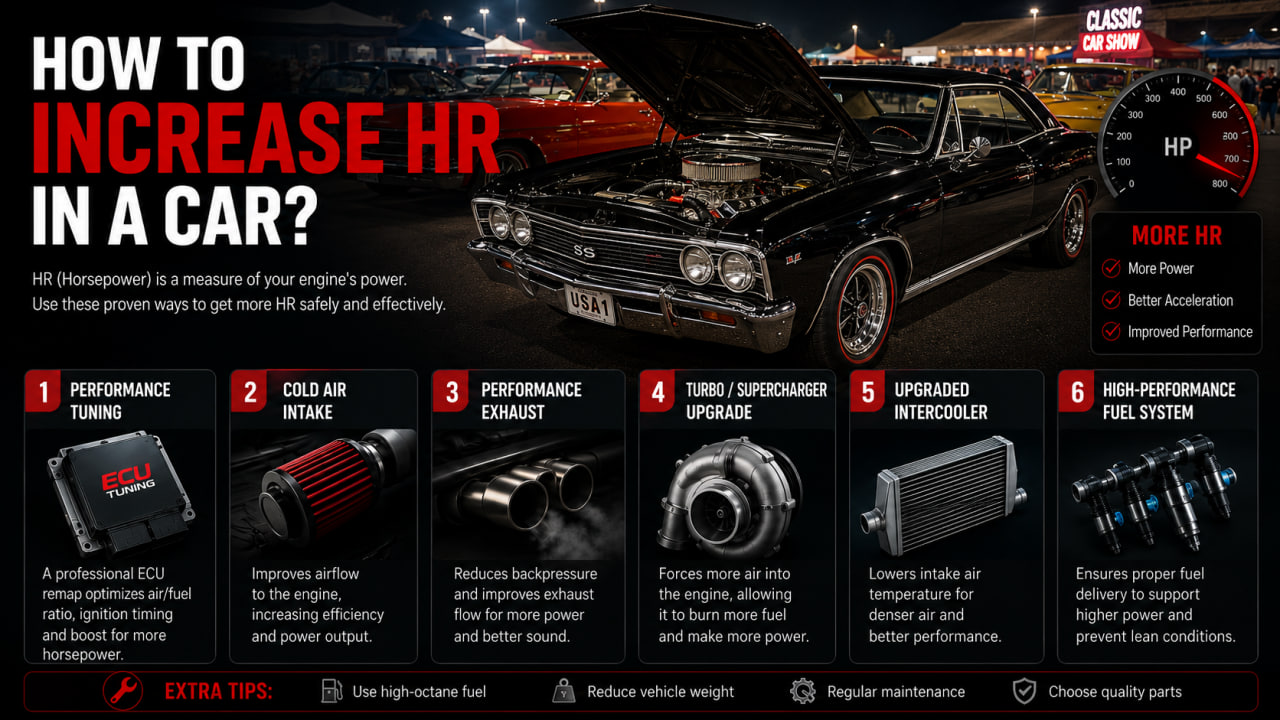 Increasing car power starts with understanding the base condition of the vehicle. A weak engine with old spark plugs, dirty filters, vacuum leaks, poor compression, overheating problems, or failing sensors will not respond well to expensive upgrades. Before adding performance parts, the car should run clean, idle smoothly, shift correctly, and hold proper operating temperature.
Start With Maintenance Before Performance Parts
The cheapest horsepower is often the power the car has already lost. A neglected engine can feel slow because it is not breathing, firing, cooling, or fueling correctly. Basic maintenance may not create huge peak horsepower, but it restores throttle response and gives every later upgrade a better foundation.
| Maintenance Step |
Why It Matters |
Performance Effect |
| Fresh spark plugs |
Helps the engine burn fuel cleanly and consistently. |
Better response, smoother acceleration, fewer misfires. |
| Clean air filter |
Allows the engine to breathe without restriction. |
Improved airflow and more stable power delivery. |
| Fuel system check |
Weak fuel pressure can limit power and damage the engine under load. |
Safer tuning and stronger high-RPM performance. |
| Cooling system service |
Power creates heat, and heat reduces reliability. |
More consistent performance during hard driving. |
| Sensor inspection |
Bad oxygen, MAF, MAP, or temperature sensors can hurt the tune. |
Cleaner fueling and better ECU control. |
Improve Airflow: Intake and Exhaust
An engine is basically an air pump. To increase horsepower, the engine needs to move air in and out more efficiently. A quality intake can help the engine receive cooler, cleaner, less restricted air. A better exhaust can help gases leave the engine faster. These upgrades are most useful when the parts are matched to the vehicle and supported by proper tuning.
Not every loud exhaust adds real power. A poorly chosen exhaust can reduce low-end torque, create drone, and make the car unpleasant to drive. The same applies to cheap intake kits that pull hot air from the engine bay. The goal is not noise; the goal is controlled airflow.
Cold Air Intake
A good intake can improve throttle response and airflow, especially when paired with a proper tune and a healthy engine.
ECU Tuning and Remapping
ECU tuning is one of the most important ways to increase horsepower safely. The ECU controls fuel, ignition timing, boost pressure on turbo cars, throttle behavior, and many protection strategies. A professional tune can unlock power from intake, exhaust, turbo, supercharger, injector, and fuel upgrades.
A bad tune can destroy an engine. Too much ignition timing, lean air-fuel ratio, excessive boost, or poor knock control can cause detonation, overheating, broken pistons, damaged valves, or turbo failure. This is why dyno testing and data logging matter. The tuner should check air-fuel ratio, knock, intake temperatures, exhaust gas behavior, fuel pressure, and engine load.
| Tuning Type |
Best For |
Risk Level |
| Stage 1 tune |
Mostly stock cars with small intake or exhaust changes. |
Low to medium if done correctly. |
| Stage 2 tune |
Cars with downpipe, intake, exhaust, or fuel-supporting parts. |
Medium because heat and fueling become more important. |
| Custom dyno tune |
Modified engines with unique part combinations. |
Depends on tuner quality and engine condition. |
| Forced induction tune |
Turbocharged or supercharged builds. |
High if cooling, fuel, and engine strength are ignored. |
Forced Induction: Turbo and Supercharger Power
Turbochargers and superchargers can create major horsepower gains because they force more air into the engine. More air allows more fuel to burn, which creates more power. But forced induction is not a simple bolt-on upgrade for every car. The engine must handle the pressure, the fuel system must keep up, and the cooling system must control the extra heat.
Before adding a turbo or supercharger, check compression, oil pressure, fuel delivery, transmission strength, clutch condition, cooling capacity, and engine management. A boosted car with weak supporting parts can be fast for a short time and broken soon after.
Upgrade Fuel, Cooling, and Supporting Parts
When horsepower increases, the supporting systems must increase with it. Fuel injectors, fuel pump, intercooler, radiator, oil cooler, clutch, transmission, differential, axles, tires, and brakes may all become part of the build. Power without control is not a complete upgrade.
Fuel System
Higher power needs stable fuel pressure and enough injector capacity. Running lean under load can damage the engine quickly.
Cooling System
More power creates more heat. Better cooling keeps the engine consistent and helps prevent overheating during hard use.
Brakes and Tires
A faster car needs better stopping and traction. Horsepower is only useful when the car can put it safely to the road.
Best Order to Increase Power
The smartest tuning path is step-by-step. Do not install random parts without a plan. Each upgrade should solve a specific restriction or support the next level of power.
| Step |
Upgrade Area |
Purpose |
| 1 |
Maintenance and diagnostics |
Restore lost performance and confirm the engine is healthy. |
| 2 |
Air filter, intake, exhaust |
Improve breathing and throttle response. |
| 3 |
ECU tune |
Make the engine use upgrades correctly and safely. |
| 4 |
Fuel and cooling support |
Protect the engine under higher load. |
| 5 |
Turbo, supercharger, camshaft, or internal engine work |
Create serious power gains with stronger supporting parts. |
| 6 |
Brakes, tires, suspension, clutch |
Make the car usable, safe, and balanced. |
Common Mistakes That Reduce Reliability
Many drivers damage their cars because they chase horsepower before understanding the full system. A performance car is not only the engine. It is airflow, fuel, spark, cooling, drivetrain, brakes, tires, and the driver. If one part is weak, the whole build becomes risky.
- Installing a loud exhaust with no real performance benefit.
- Using a cheap tune without data logging or dyno verification.
- Adding boost before checking engine compression and fuel capacity.
- Ignoring cooling upgrades on a car that already runs hot.
- Using poor-quality fuel after increasing timing or boost.
- Adding power without improving tires, brakes, and suspension.
- Removing emissions equipment where it is not legal.
- Expecting one part to create a huge horsepower gain by itself.
Street Use, Legal Rules, and Realistic Expectations
Power upgrades should be legal for the area where the car is driven. Some exhaust, catalytic converter, ECU, and emissions changes may not be street legal. A car can be stronger and still stay responsible if the owner chooses legal parts, keeps safety equipment working, and avoids reckless driving on public roads.
Realistic expectations are important. A naturally aspirated car may gain a small amount from intake, exhaust, and tuning. A turbocharged car may respond much more strongly to an ECU tune. A serious build can make large gains, but it usually costs more because supporting parts become necessary.
Quick Upgrade Comparison
| Upgrade |
Possible Benefit |
Best Use |
| Maintenance refresh |
Restores lost response and smoothness. |
Every car before performance work. |
| Cold air intake |
Better airflow and sound. |
Cars with restrictive factory intake systems. |
| Cat-back exhaust |
Improved flow and tone. |
Street builds where sound and mild flow matter. |
| ECU tune |
Better power delivery and optimized engine control. |
Modern cars, especially turbocharged engines. |
| Turbo or supercharger |
Major power gain potential. |
Built or healthy engines with supporting upgrades. |
| Camshaft upgrade |
Stronger high-RPM power and different engine character. |
Engines built for naturally aspirated performance. |
| Weight reduction |
Improves acceleration without adding engine stress. |
Track cars, weekend builds, and budget performance projects. |
FAQs
What does HR mean in a car?
Most people mean HP, or horsepower, when they write HR in a car performance question. This guide treats HR as engine power and explains how to increase it safely.
What is the first thing to upgrade for more horsepower?
Start with maintenance and diagnostics. Fresh spark plugs, clean filters, good fuel pressure, healthy sensors, no leaks, and correct fluids should come before expensive parts.
Does a cold air intake increase horsepower?
It can help, but results depend on the car. A quality intake works best when it brings in cooler air, avoids heat soak, and is matched with a proper tune if needed.
Is ECU tuning safe?
ECU tuning can be safe when done by a skilled tuner with proper data logging, correct fuel, and respect for engine limits. A bad tune can cause serious engine damage.
Can I increase power without damaging the engine?
Yes, but the build must be balanced. Keep the engine healthy, upgrade in stages, use quality parts, tune correctly, and support power with fuel, cooling, brakes, tires, and drivetrain upgrades.
-----------------------------------------------------------------------------
Build Power the Smart Way
The right way to increase car power is not to install every part at once. Start with the condition of the engine, choose upgrades that match the vehicle, tune the ECU correctly, and keep safety in mind. A car with balanced power, reliable cooling, strong brakes, and good tires will feel better than a car with random parts and no plan.
|